



In basketball, successful teams often run drills in which they execute their most valuable plays over and over. The “pick and roll” is one of the most basic–and effective–plays. In it, a player screens a teammate’s defender, allowing the teammate to drive to the basket, or they can throw a pass to the screener, who can then roll to the basket. In a recent presentation, Richard Soliz of Seminole ISD compares the “pick and roll” to entry and exit tickets.
Entry and exit tickets are repeatable, high-value activities that only grow more effective with frequency and practice. In this blog, we’ll talk about why entry and exit tickets are so effective, some common pitfalls, and some suggestions for implementing this easy formative assessment strategy in your classroom.
First, meet Richard Soliz, who gave this presentation at Eduphoric 2026.

Why should you start using entry and exit tickets (the right way)?
If you’re like most classroom teachers, you’re supporting dozens of (if not, near a hundred) students every day. You may be craving data to help you reach students who are falling behind. You may also be drowning in data from formative assessments and are so overwhelmed that the data is not informing instruction.
Entry and exit tickets are a great way to gather individualized student data on learning gaps, styles of learning, and metacognitive strategies. In other words, they are fast and easy formative assessments. If you build a system, it’ll keep you from losing that valuable, time-sensitive data.
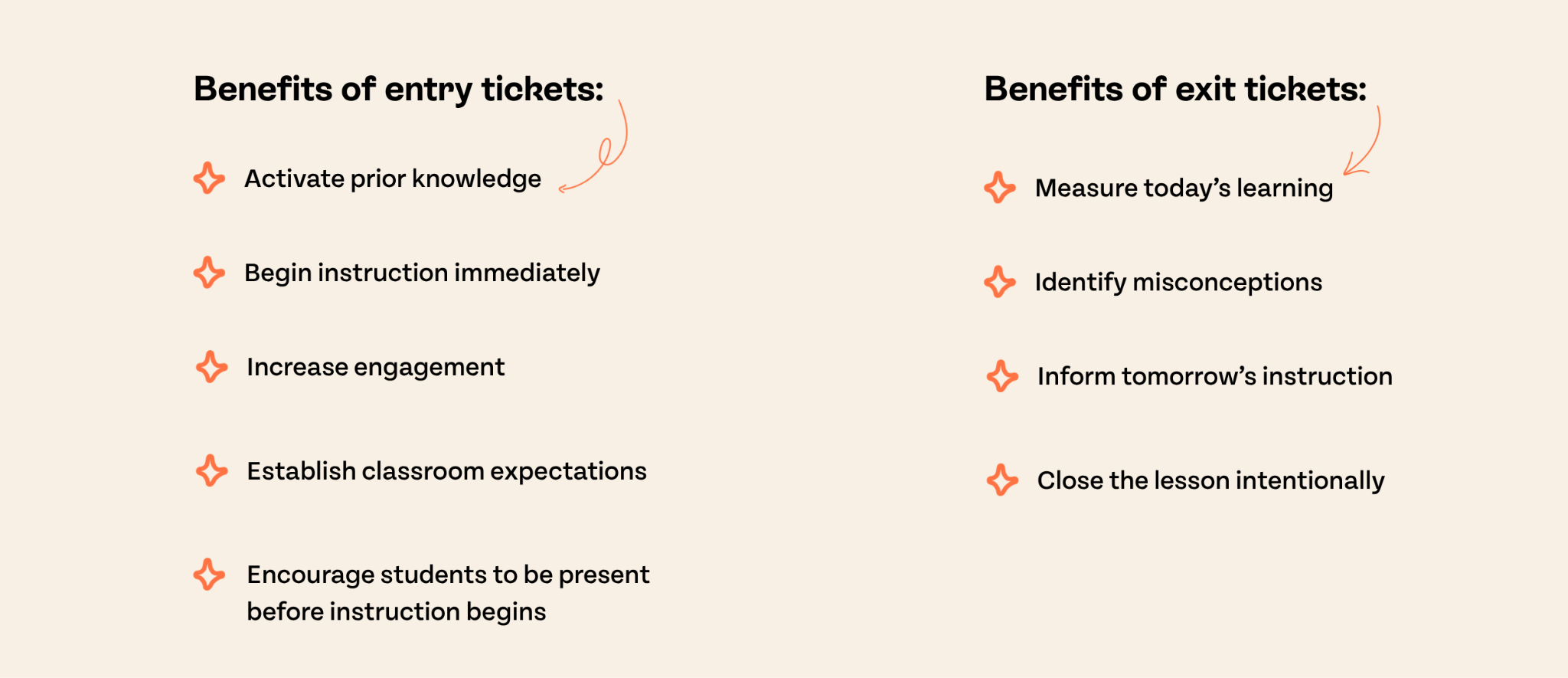
Is there a “wrong way” to use entry and exit tickets?
Everything your student is doing in your classroom should be used to further their mastery or inform instruction. If entry and exit tickets are being used as “busy” work, such as non-subject or grade-level worksheets, then that time and effort isn’t serving you or the student.
We don’t want to say there’s a “wrong way” to do something, but for the purpose of this article, we’ll call out some ways that using entry and exit tickets can waste their potential as formative assessment tools, including:
- Effectively employing entry and exit tickets to gather data, then letting that data go to waste
- Writing tickets that have nothing to do with the current unit’s lessons and standards
If you’ve fallen victim to the data overwhelm trap where formative assessment data goes to die, don’t worry, we’ve got a system that can help you establish a method of gathering and immediately utilizing the data you gather to help students grow.
How can you start using entry and exit tickets in your classroom?

If you’re not already using entry and exit tickets (or you’re using them but aren’t using them), you may be wondering how it would be possible to read every entry and exit ticket and craft a strategy to grow individual students. That’s a fair question! In a job where time is at a premium, isn’t this something that would take a lot of time that you simply don’t have?
Entry and exit tickets don’t have to bog you down and take up your valuable time. Let’s get into some implementation strategies, along with notes and suggestions for making the most of this formative assessment method without getting overwhelmed.
Start small and build a routine first
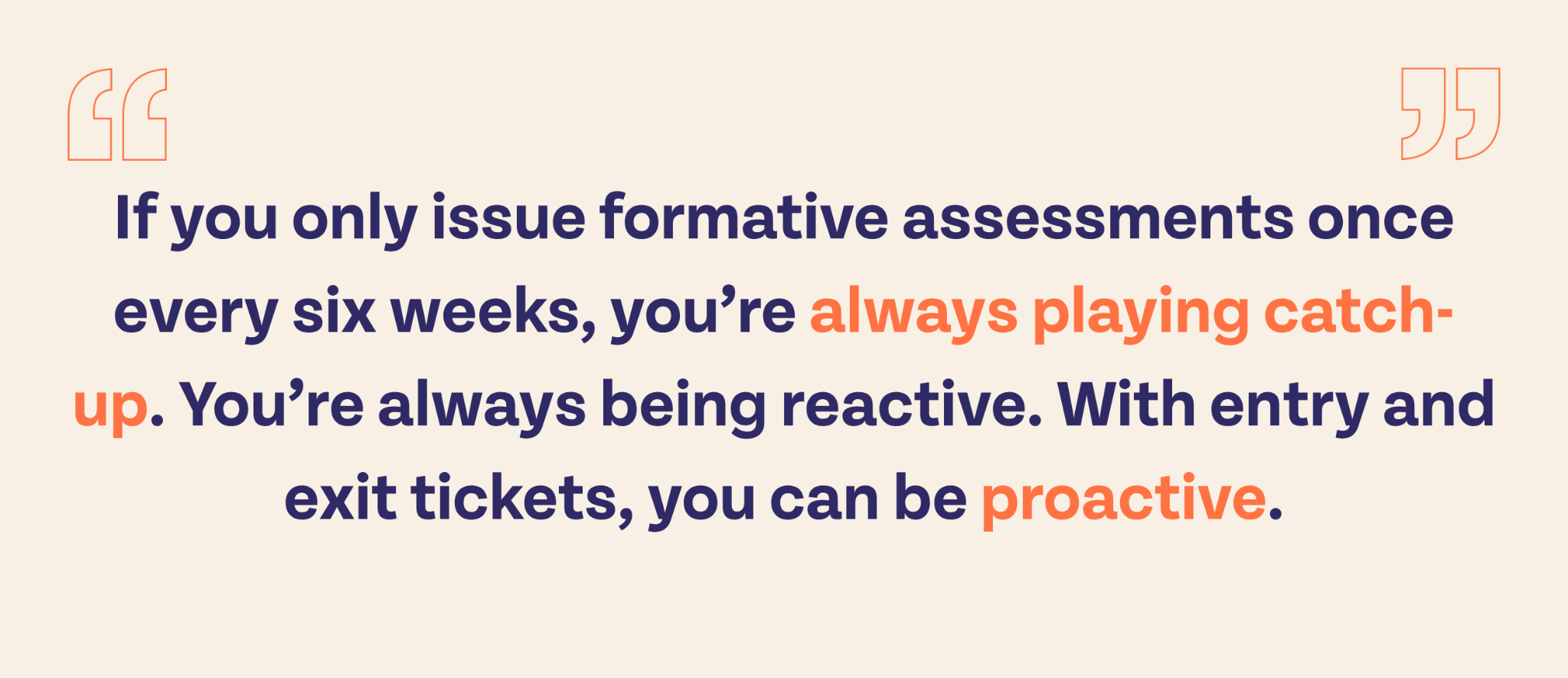
Starting a new assessment practice from scratch may sound overwhelming, especially if you’re already drowning in grading and building new routines. However, you don’t have to build a fully integrated entry and exit strategy on the first day.
Why not try using only entry tickets for three days a week for the first six weeks and slowly build on from there?
Get used to gathering data in a consistent, reliable way, then make your entry tickets more frequent. In semester two, or whenever you’re ready, you can add exit tickets to your routine a few days a week, building up to 5 entry and 5 exit tickets every week.
Whatever you practice, do it consistently. If you can only manage an entry and exit ticket once a week, that’s one more formative assessment a week that you can use to improve your students’ growth.
Automate your ticket collection and analysis
If grading and turning student responses into data is your biggest hurdle to implementing entry and exit tickets, why not automate your process?
If you’re using the sticky note system or other paper processes, no wonder you’re overwhelmed with student responses. It’s time to go digital.
You can buy software that automates your data collection and creates data visualizations for you, but you can also use free tools like Google Forms.
Did you know that you can create data visualizations with Google Forms, such as pie charts? You can also isolate certain responses in Forms to identify student groups who need specific interventions. If you want to be even more advanced, filter student responses into a spreadsheet, which can also generate data visuals.
Address tickets immediately by building that time into your schedule
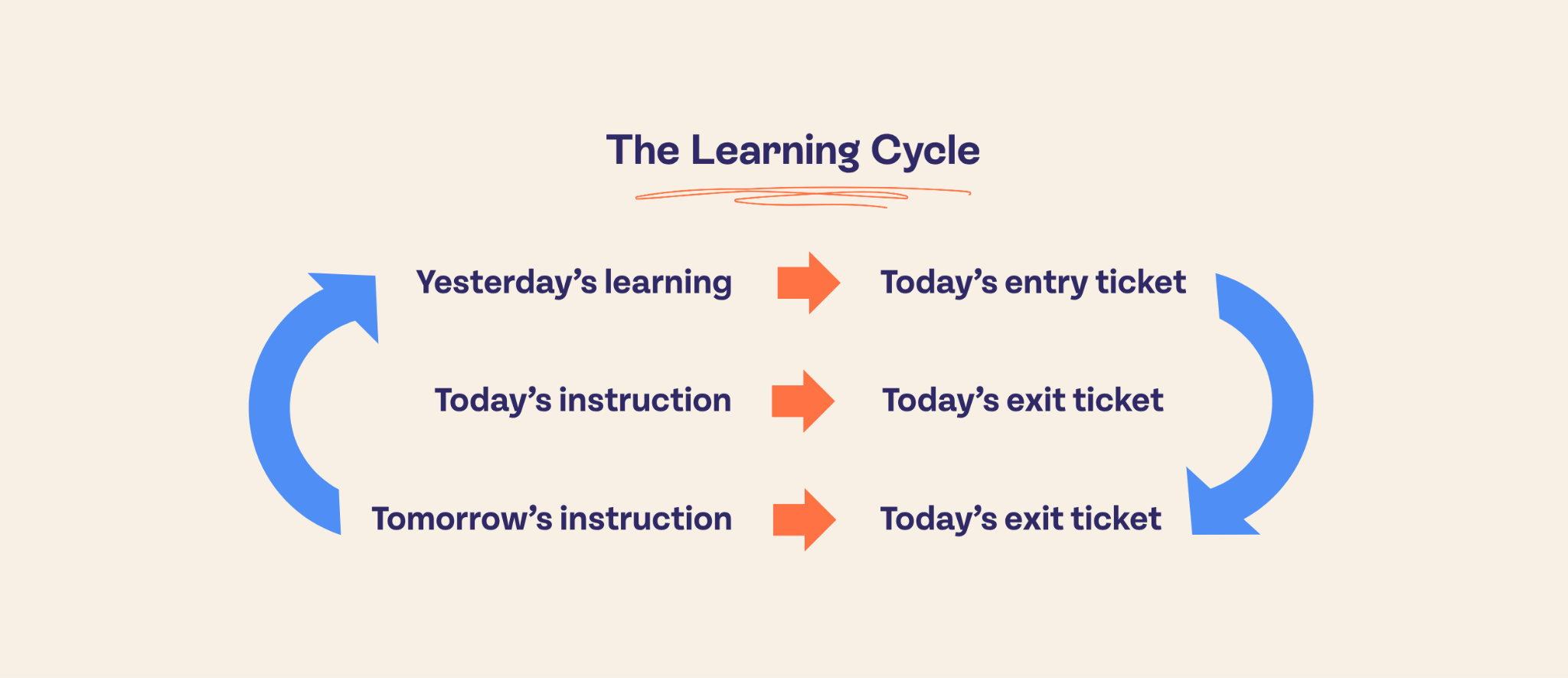
If your entry and exit tickets form a cohesive system, then you’ll always know what kind of question needs to come next. As you can see in the graphic, the cycle shows the subject matter your tickets need to cover.
Yesterday’s learning should inform today’s entry ticket; today’s instruction should inform today’s exit ticket; and tomorrow’s instruction should inform today’s exit ticket. Here’s an example.
If yesterday’s instruction was about verbs and today’s instruction is about nouns, my entry and exit tickets could look like this:
Today’s entry ticket: Write an example of a verb.
Today’s exit ticket: Write an example of a noun.
Tomorrow’s entry ticket: Write an example of a noun and a verb.
Your tickets shouldn’t be the same between class periods
Here’s another potential sticking point. Your entry and exit tickets shouldn’t be the same between class periods. That means you’ll need an entry and exit ticket for every class period for every day of the week. Why? Because students talk! If your students are discussing the assessment between class periods, you aren’t getting accurate data.
So, how can you possibly manage around 20 or 30 tickets a week?
One solution could be subscribing to an item bank. Our Aware customers can purchase item banks to draw on for assessments, allowing teachers to build formative assessments like these in minutes.
However, if you’re writing them from scratch, there are a few things to keep in mind:
- Questions need to be able to capture very high depth of knowledge and very low depth of knowledge to make sure students are getting the basics.
- Every assessment should answer one question: What should I do tomorrow? Do I need to take a step back and reteach this, or are we ready to move on? That’s the purpose of the entry and exit tickets.
Richard’s recommendation for the threshold is 60%. If 60% of your students passed the assessment, you can move on and pull the remaining 40% for intervention. Less than 60%, and you need to reteach the entire lesson to the entire class.

Engage students and reward participation with graded tickets
Attendance is becoming a larger and larger issue. As attendance drops, or tardies go up, you’ll have more and more students missing your entry ticket. If you assign these as a grade, say 20 points per ticket, that amounts to a full, easy A a week. This may incentivize and motivate students to get to class on time.
We have software for every step of the entry and exit ticket routine
If you’re not doing your formative assessments digitally, you’re asking for data overwhelm and lost opportunities to proactively support students. We have software that can help you create an entry and exit ticket formative assessment system quickly and easily.
Our software was built to give teachers fast, accurate insights into student performance using data visualizations like Single Test Analysis.
However, if you want to hear an expert talk about how our tools can solve your data needs, watch the webinar with Richard’s full presentation, assisted by our sales executive, Emily Cram. Emily has tips and tricks, not just for using the software, but for implementing this system in a way that sticks and immediately benefits students.
Share this with your team
Is your team hungry for data? Or, are you overloaded with assessment results and unsure what to do with it all? Share this article! We’re confident that entry and exit tickets can radically change the culture of assessments in your school and provide immediate and positive results for student growth.



%20(1).png)
%20(1).png)
%202.png)
.png)