


Teachers are facing a lot of problems these days, but we’d argue that the biggest one is this: you are under extreme pressure to support and uplift students with few resources and even fewer hours in the day.
You want to push your students into the next tier of achievement. You want to see them improve and achieve at their highest potential. You want to do all of this while creating engaging lessons and building relationships. It’s not easy to care for students in all the ways you’re expected to.
In this blog, we want to break it down. How do you teach to the individual student without working hours after school? How do you know that a student needs extra help, and what kind of attention is enough to help them improve? Use the table of contents below to find the answers you’re looking for.
Table of Contents
Interventions vs. Enrichment: What they are and when to provide them
How do you know if students need extra attention?
Creating interventions for each type of learning gap
Why should you create enrichment for students who are ahead?
Beacon makes differentiated instruction fast and easy to implement
An intervention is an individualized teaching approach meant to help the student improve academically or behaviorally. It is usually driven by data and observation and is administered either one-on-one or in small groups.
Enrichment is an individualized teaching approach meant to help the student excel and stay engaged in lessons and activities when they’re ahead of their peers. These can also be given one-on-one or in small groups.
Both intervention and enrichment are equally important to student morale, behavior, and academic success. For one thing, if students who are ahead are being provided with enrichment, you as the teacher can have more time and energy to devote to students who need to spend more time in a lesson or unit until they’re ready to move on.
Students shouldn’t feel like they’re getting left behind because they learn at a different pace than their peers.
When should you provide interventions?
Interventions should be provided after every check-in. This could be formal (after an assessment or assignment) or informal (after a conversation with or exit ticket from the student).
Both this formal and informal data tell you what kind of intervention the student needs.
Here’s an obvious example. After an assessment, you find that the student is struggling with a learning standard that they need to master in order to move on to the next unit. The next step is to work with them individually or with a group to help them understand that standard.
A less obvious example might include having a conversation with a student where they admit that they don’t enjoy the subject matter, so they’re having a hard time staying engaged, are checking out during the lesson, and they’re disrupting other students. Your intervention might be to alter their lesson or activity to include an interest of theirs. You direct them to do some research that helps them stay engaged, interested, and non-disruptive.
When should you provide enrichment?
There are several different reasons you might want to provide enrichment for some of your students. Here are some examples:
- One student (or several) has mastered the subject matter and is needing something more challenging, interesting, or engaging.
- Most of the class is ready to move on, but you have some stragglers who need just a little bit more attention until they’re ready to move on with the rest of their classmates.
- One student regularly excels and needs something more challenging and engaging, even before they’ve mastered the content.
Here’s an example of how you could provide enrichment in one of these scenarios. Let’s say your brightest student is bored because they’ve finished their work, they aced their assessment, and they are interested in learning more but have nowhere to direct their energy.
To help them feel like they’re still learning and receiving attention from you, you may give them time to do self-directed research into the next unit. You could also give them a project that helps them apply their knowledge to a real world problem. Or, you could pair them with a student who needs intervention to see if teaching classmates keeps the student engaged and practicing their knowledge.
You can identify that a student needs extra help through some traditional methods, such as assessment scores and assignments, but there are other, faster ways to gather information about student needs, including informal observation, conversation with the student, and data gathering during lessons and activities.
Because this blog is about assessment data as an indicator of student needs, let’s talk about that first.
How can assessment data tell you when a student needs help?
Data analysis can be a difficult skill to master, especially if you have limited time, energy, and technology. So, here are some basic indicators that a student might need intervention:
- They’ve failed a test
- They missed every question (or most questions) relating to a specific skill or learning standard
- Their performance on a recent assessment is much different from their usual performance level
- They didn’t answer one or multiple questions
- They chose the distractor answer choice
- They indicated a low confidence level about their answers on an assessment
- They indicated a high confidence level about their answers and still answered incorrectly.
Even if you don’t have a robust data analysis software, it should be fairly fast to gather these kinds of insights. Though, it would help you more effectively analyze this data if you knew ahead of time what your goals were for the student.
We wrote a resource on how to use MTSS to make data-based decisions for students. Check that article out for more in-depth information on screening and intervention. For the sake of this article, we’ll summarize a few important points here:
- If we’re responding to student needs based on data, we’re often a little late. We should be proactively supporting students and assessing how effective our methods are by measuring progress.
- Screening students for learning gaps and behavioral issues is more effective when it’s standardized.
- A student’s emotional and behavioral health is inextricable from their academic health and wellbeing. Assessing academic needs can’t be separate from assessing their other needs.
- Building a relationship with the student so that you can know and predict their needs will make your job easier and your interventions more effective.
Using student behavior and informal data to tell if a student needs help
Student behavior doesn’t need to be disruptive to be problematic. Students who are “checked out,” quietly need as much attention as the student who won’t stop throwing paper balls across the room into the trash can.
When I was teaching, I had a student who rarely showed up to class. When he did show up, he’d often lay his head down, refuse to work, and refuse to participate. One time, out of desperation to get anything from him, I offered him an extra credit opportunity. If he would simply read a children’s book to me, I would give him some points.
I was embarrassed for myself and angry for the student to see that he had incredible difficulty reading this children’s book to me. This student did not have an IEP. They were through with their English Language Learner track. And yet, he could barely read at a first or second-grade level.
Of course he was checked out in a sophomore-level English class.
Talk to your students. Do what you can to get them involved, to get some data, to find out what might help them improve. It’s essential.

We started this blog with some commiseration. You don’t have time or resources, and yet students need you. How do we get students the help they need with the limitations that are placed on you as their teacher?
First and foremost, creating student agency will help you to build capacity in your students to solve problems for themselves, advocate for their learning needs, and stay engaged.
Student agency is when a student is self-motivated and goal driven. They direct their own learning journey and seek out resources to build their knowledge and skills because they feel energized and equipped to do so.
That being said, even in a perfect classroom where all students are engaged and have agency, you’ll still need to create interventions and enrichment activities that differentiate for the student.
First, let’s go over the kinds of learning gaps that may be holding your students back:
- A student has a small misconception about a specific subject
- They need a refresher on a basic fact
- They aren’t using the right formula or tactic to solve a problem
- They’re misunderstanding a concept and need it re-taught or re-explained to them
- A student is missing core knowledge or skills on a learning standard
- They don’t understand how to demonstrate their knowledge correctly, e.g. the learning standard is about essay organization and they don’t understand how to correctly format an essay
- They’re repeatedly performing poorly on assessment questions associated with one standard
- They’re struggling with or have performed poorly on an assignment or activity that’s meant to help them practice or demonstrate skill on this standard
- A student is missing a foundational skill that is holding them back from completing grade-level work
- Somewhere along the line, they never learned a prerequisite skill that would help them understand this more difficult skill
- They can’t seem to understand or learn a new skill because they don’t have to conceptual groundwork for it
- They’re failing state, district-level, or other standardized check-ins even though they’re doing all right in class
These are three different examples of learning gaps that differ in “severity.” One is pretty easy to correct, and one is much more difficult and complex to correct. So, how can you create interventions for these varying levels of needs?
Examples of interventions for students with small, medium, and large learning gaps
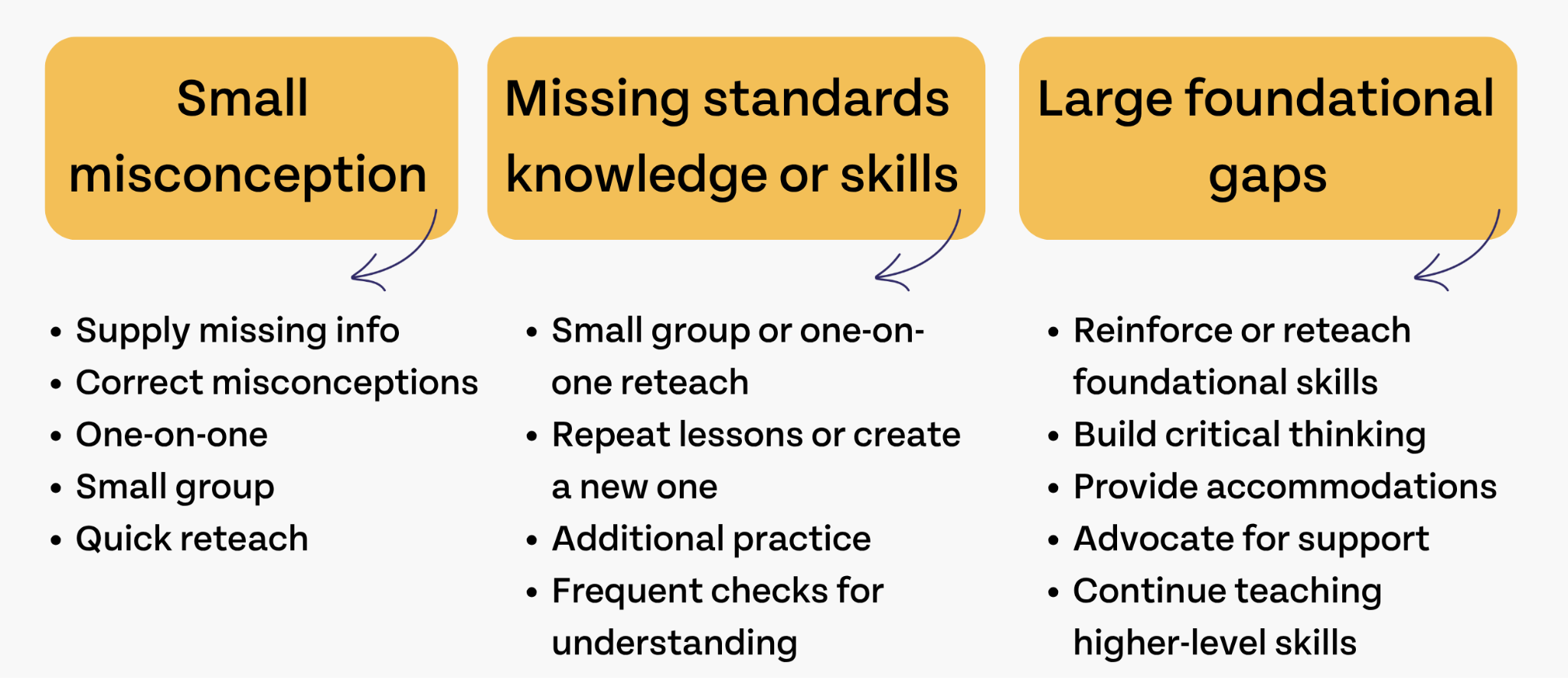
Some misconceptions can be addressed with a single conversation or one-on-one activity. Let’s say you go over test questions with the student who has a small, fact-based misconception. You can address this with them by asking why they answered the question the way they did. You confirm through this conversation that they missed a fact during the lesson that would help them, so you share that fact with them and ask them how it would change their answer.
Does it help them? Do they understand now and are they ready to move forward with this new knowledge? Perhaps it needs practice to make sure it’s ingrained, so you give them some practice activities or questions.
Bigger misconceptions might need re-teaches, one-on-one work, and group interventions. Let’s say a student can’t seem to master a learning standard and needs some time and attention to build the necessary knowledge or skills to get there. For example, the student doesn’t seem to understand the causes for World War II.
They’ve missed every question they’ve been assigned on this standard, and they didn’t turn in the assignment you created to assess this. So, you decide to pair this student with several others who have the same issue. While other students are working on projects (or doing their enrichment) you get this group together to reteach a critical lesson, being sure to stop frequently and check for comprehension. Then, you ask them to complete the assignment that they’re missing as a group.
Now, assess. Do they complete the assignment? Do they seem more confident, or will they need more time and reteaching the next class period to build those skills?
Foundational skill-level problems might need constant readjustment, accommodations, and advocacy to tackle.
Just like my student with the severe reading level learning gap, some students will have major problems with their learning that have compounded after of years of bandaid fixes. This is holding them back again and again. You might be able to help them grow these skills through intensive one-on-one work.
If you can, then it’s worth doing. For example, say a student has somehow managed to make it to Algebra II without understanding the basic functions and how they might appear on a graph. They don’t even know which axis is x and which is y. That’s a pretty big learning gap for a class that’s supposed to be talking about more complex and challenging equations.
One tactic for building this student up might be to identify conceptual standards on your Algebra II curriculum that you might be able to teach this student with Algebra I concepts. You can reteach foundational skills without letting them get too far behind their peers.
Doing nothing isn’t an option, as they will inevitably fail the class if their learning gaps aren’t addressed.
So, what if you don’t have enough time in the year to get them up to grade level? With the student whose reading level was approximately 7 or 8 years behind, I could not catch him up to the reading level he needed to be at to understand his work. However, I could prioritize those critical thinking skills that would help him succeed in the grades to come and in life beyond high school. I could provide accommodations, such as audio versions of required readings, constant dictionary access, and some reading practice that may improve his skills and, hopefully, his experience in class.
It might help to ask yourself: What is the bare minimum that this student needs to succeed beyond my class?
For me, that answer was often critical thinking and analysis skills. If I could get them to analyze anything (it didn’t have to be Edgar Allen Poe or The House on Mango Street), then I would have taught them an essential skill that will help them succeed.
If you can, speak to your admins about what can be done for the student
If you’re ever surprised to see how far behind a student is, it’s worth bringing up to your administrators for guidance. It’s entirely possible that this student has a learning disability that has gone under the radar. Perhaps they can be given resources and materials that will help them thrive in their other classes. Or, maybe your administrator has suggestions for courses, tutoring, or other tactics that might help your student get caught up.

Creating enrichment for students who are ahead gives your other students a chance to learn what they need to learn in a low-pressure environment. Plus, it keeps your advanced students engaged, motivated, and on-task.
When you’re dealing with a rowdy classroom of students who are all in at least five different places in their learning, it might seem easy to let the students who are done with their work and acing their assessments to their own devices. After all, you’ve got ten other students whose hands are constantly up.
Plus, many students will resent being asked to do more after they’ve done what they’re told. Shouldn’t they be rewarded for finishing their work?
Yes! They should be rewarded! Enrichment can be a rewarding experience that allows the student to decompress from more academic, standards-focused tasks while preparing them for future lessons or deepening their understanding of the current standards.
For example, let’s say a student has mastered the life cycle. The next unit will be how animals form adaptations for survival. Most students have a favorite animal. What if you found a documentary together about the student’s favorite animal? Tell them you will check in with them after they finish the documentary about how you think the animal survives in their environment.
In this way, you’re not only able to check their knowledge on the animal’s life cycle (current unit) but can prep them to be thinking about adaptations (next unit).

Speaking of issues facing teachers today, are you having to juggle multiple log-ins and confusing applications to create and administer assessments and plan curriculum? Our goal is to make our technology so easy to use that it fits seamlessly into your processes.
If your software feels like you’re trying to jam a square-shaped peg into a star-shaped hole, then there’s a problem. You shouldn’t have to bend and break what you’re already doing to make your technology work for you.
Beacon is our curriculum management software. It integrates with Aware, our assessment creation, administration, and data analysis software, so you can create targeted curriculum that you feel good about.
See your assessments in your planner
Because Beacon integrates with Aware, you can not only see assessments that are coming up in your planner, so you can properly prepare. You can also look back on assessments associated with past units to see if your interventions and enrichment are working.
Did you know that Aware also includes Retest capabilities? Link your retests in your planner, so you can keep your students progress data top-of-mind.
Drag and drop individualized teaching strategies into your plans
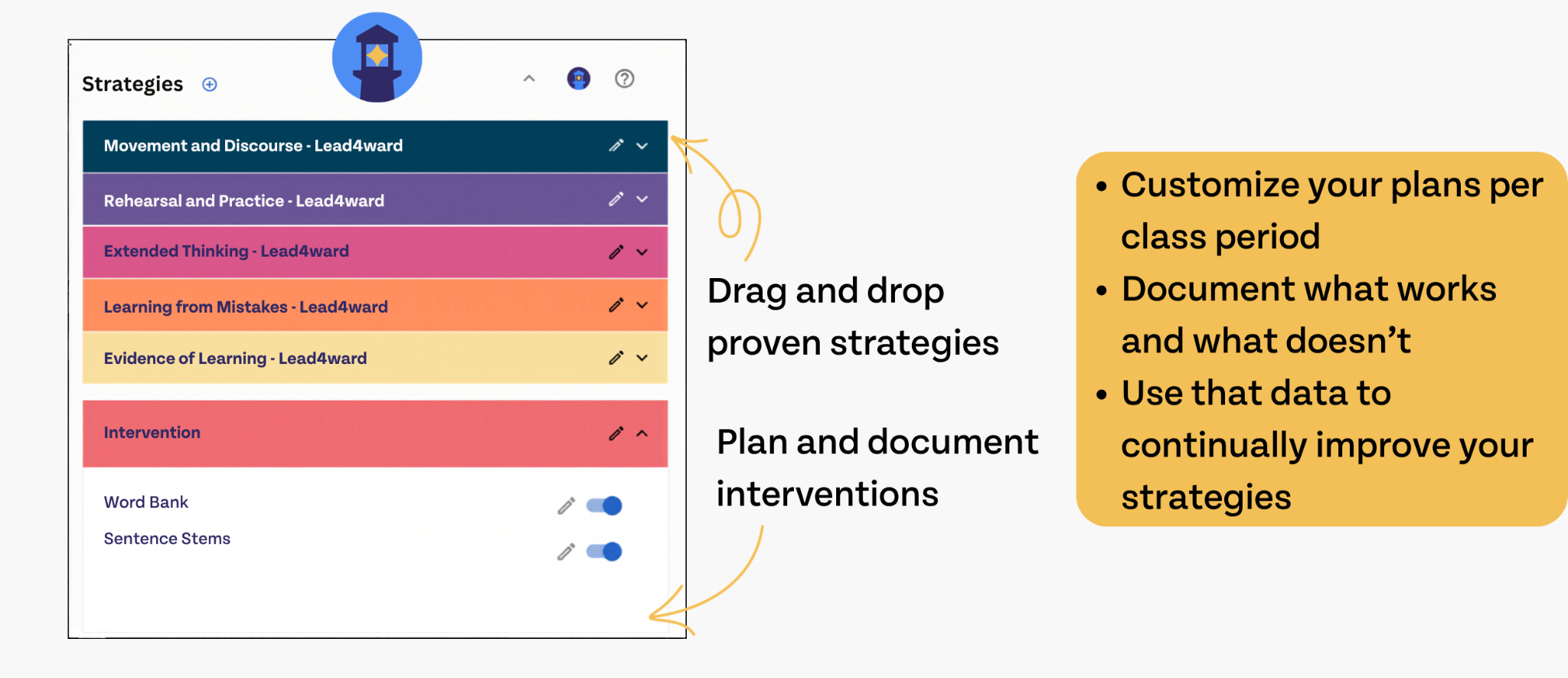
Once you know what your students need, you shold be able to make fast, easy adjustments to your lessons to plan for their intervention and enrichment. With Beacon, you can drag-and-drop proven strategies into your lessons.
Easily access and manage your resources, so you can pivot and adapt
As a former teacher, I know how annoying and time-consuming it can be to find “that one slideshow” you used to teach a specific lesson, especially if you need to reference it for a reteach.
Perhaps you need to quickly print a lesson resource for a student who needs a new copy, but you can’t spend the next ten minutes searching your drive.
In Beacon, your resources are easy and quick to access. Our curriculum explorer is organized, always updated, and easy to use. Plus, you can always go back to the lesson you used to teach specific lessons and find the resources readily accessible.
Subscribe to our newsletter to see how our software solves everyday problems for teachers
We put out a newsletter twice a month. We’re always using experts in our company and community to talk about topics that are important to you, so stay tuned on everything we publish with our updates newsletter. Subscribe at the “stay up to date” box at the top of this page.




%20(1).png)
%20(1).png)
%202.png)
.png)