


.png)
Recently, we conducted a survey with our newsletter audience asking if and when AI grading should be used. Out of more than 1,000 respondents, more than 600 voted that AI should never be used to grade.
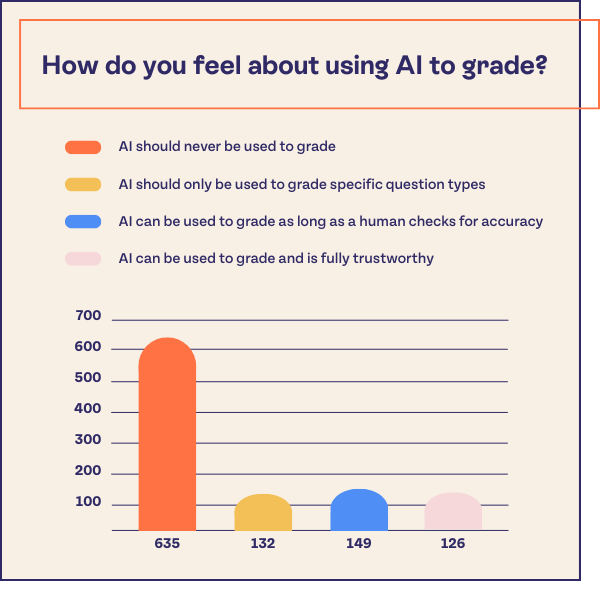
Considering the environment in which teachers are operating…the inundation of AI tools…the lack of protocol at the district-level, it makes perfect sense why this response is so common. Plus, our conscientious readers mostly believe that the grade is a means to better understand the student.
With the release of AI scoring at Eduphoria, we’ve been working to develop implementation suggestions that will empower the teacher and the student with this time-saving tool. We’re releasing several resources that will be helpful to educators across the country as they implement their own AI protocols.
In this article, we’ll be talking about what AI grading really is and how you can ethically use it to support student learning, save time, and build relationships. First, let’s get on the same page with our company’s thoughts about AI in the classroom.
AI should never replace the teacher

In 2025, Duolingo CEO Luis von Ahn asserted that AI would soon replace teachers because it can provide a more personalized and scalable education than a human could.
Obviously…we disagree. Strongly.
There is no one better to teach our students than you. However, if you are like most teachers in our nation, you are struggling with a heap of responsibilities, expectations, and time constraints that make your job difficult. So, a huge part of the conversation around AI adoption centers around ways to give you more time to teach while spending less time on the manual work that eats up your time.
As a company, we believe that AI should assist the teacher and never replace the teacher. Our goal is to equip educators with time-saving tools that enable them to focus on students.
Reckless AI companies often peddle solutions meant to replace the most important aspects of your job with little to no concern as to whether it does any particular task well. Careful adoption will mean that you can be more effective in the tasks that you are most capable of and most passionate about doing as a teacher.
Examples of AI tools that replace rather than assist the educator
As a teacher, what would you say are the most important, impactful aspects of your job (outside of building and maintaining the student relationship)? For us, it was always the conversations we had that would lead to “aha” moments. When a student has a realization that helps them overcome a barrier, fills them with confidence, and gives you a moment of connection with them, every other aspect of the job becomes worth it.
If an AI tool is having those conversations with students, you are missing out on important moments of connection. You are also missing out on your own opportunities to learn that can help you better understand the student, their metacognitive capabilities, and their learning needs.
Perhaps if you are using a tool that helps students practice metacognition, this can be a practice that assists rather than replaces you if these conversations are used as data to individualize their learning and to inspire your own conversations with them.
Is AI coming between you and the student and forming a better relationship with them than you are? It’s worth taking a second to ask whether this truly adds value to your life, the student’s life, and their learning journey.
What is the difference between AI scoring and machine scoring?
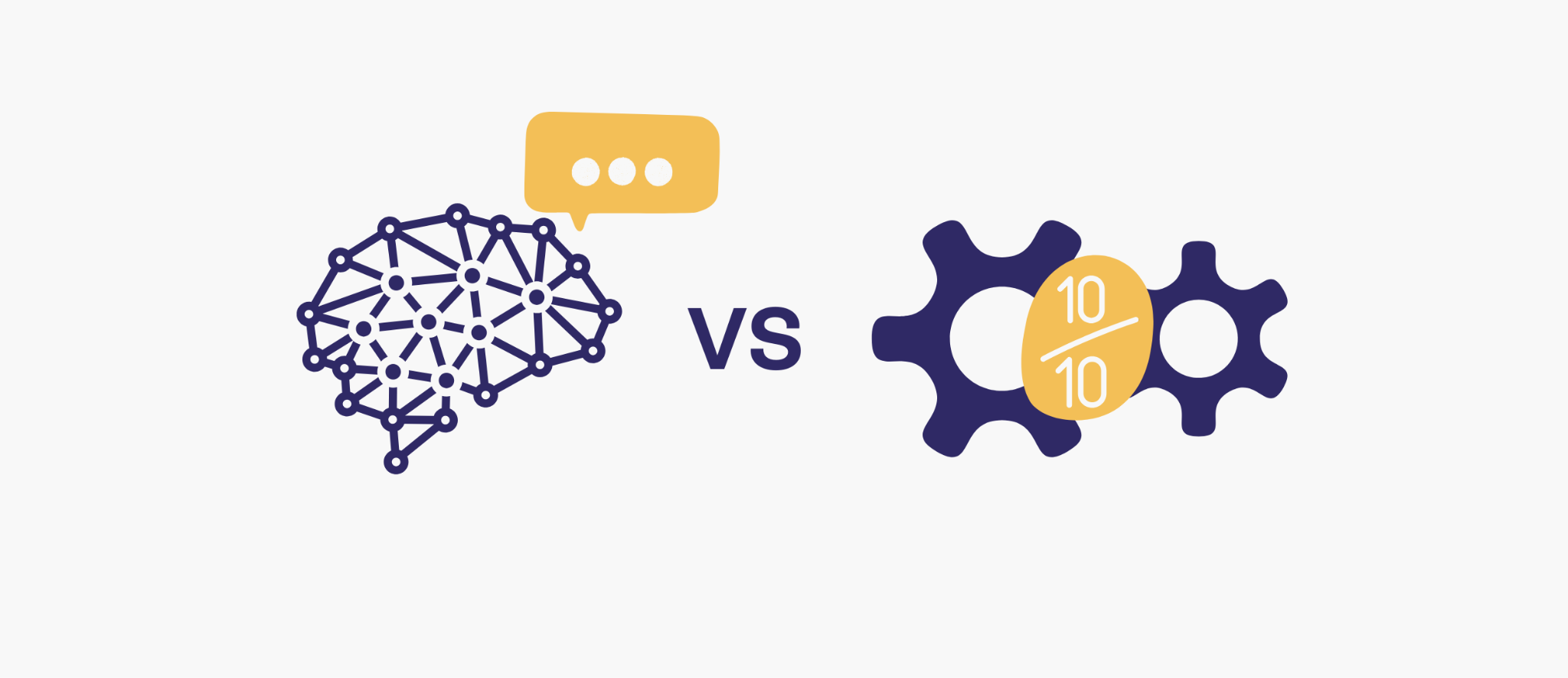
While machine scoring follows a more rigid set of rules, programmed by a group of experts, to grade a response, AI scoring is often trained on large amounts of data to recognize the desired attributes in a response with more nuance and flexibility.
Since West Virginia implemented automatic scoring for essay responses in 2005, many other states have followed suit.
In 2023, the Texas Education Agency (TEA) started using hybrid machine scoring to score about 75% of constructed responses on the state assessment. In the case of the machine scoring used by TEA, it was programmed by engineers using the grading patterns of real teachers to assess constructed responses with a certain level of confidence.
If a response cannot be scored with a certain level of confidence, then it is passed on to a human scorer. The Automated Scoring Engine (ASE) is regularly monitored to ensure its scores align with the “anchor sets” scored by humans.
AI scoring is typically performed by a large language model (LLM) trained on vast amounts of data to identify high-quality responses. Recently, we discussed some of the dangers of AI and large language models, including the difficulty of controlling where this data comes from and the child protection laws that prevent these models from using student responses to train.
AI scoring is typically considered more adaptable, as it can “learn” what constitutes a high-quality answer and assess a constructed response with greater nuance than an ASE. However, ASEs don’t have to worry about child privacy laws.
What is the purpose of “the grade,” and can AI help fulfill that purpose?
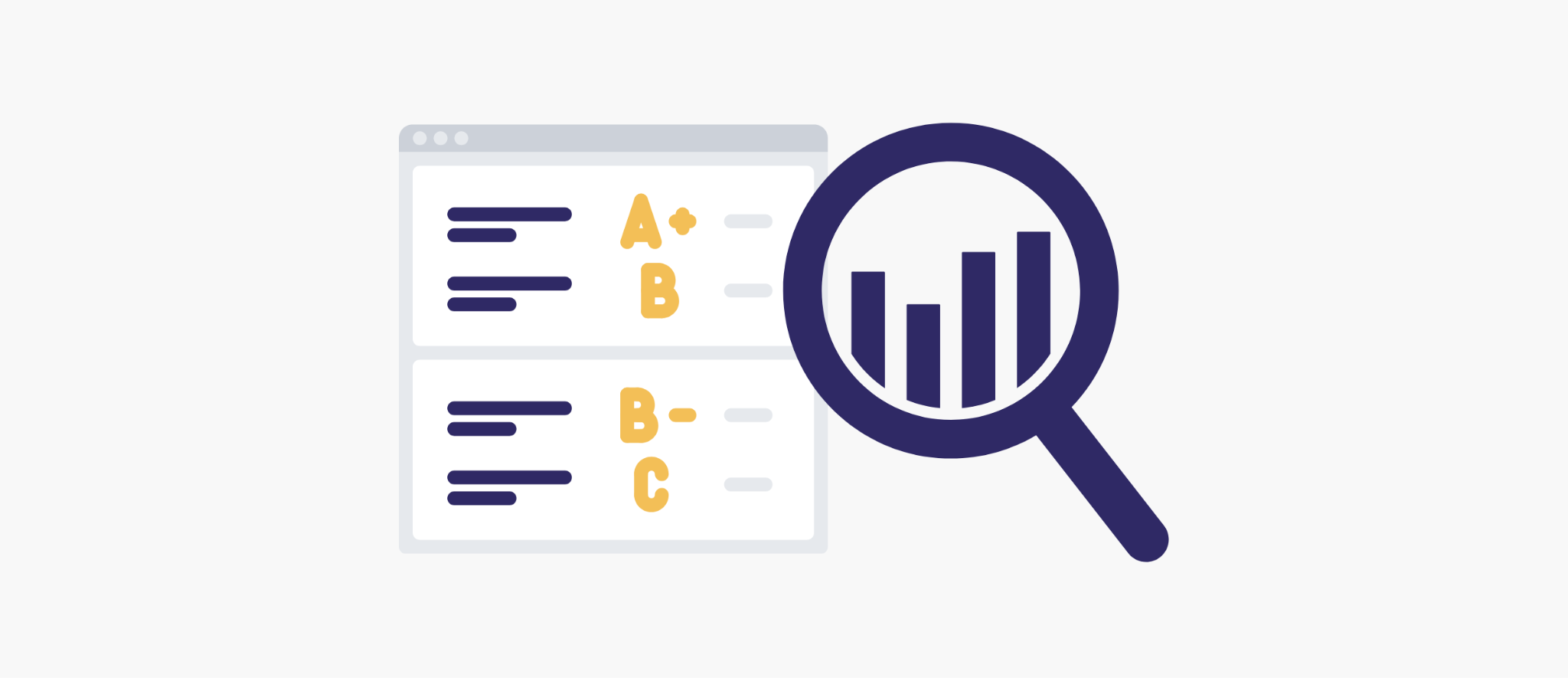
There are many different grading philosophies around the United States. For some, grading is a way to average a student’s efforts and progress over time. For others, grades are markers of a student’s mastery of the subject and should be updated as the student becomes more proficient.
For the purposes of this article, we’ll focus on the philosophy of using grades as a marker of student proficiency. Normally, grading under this philosophy is a way to understand a student’s depth of knowledge as well as where they might need enrichment and intervention.
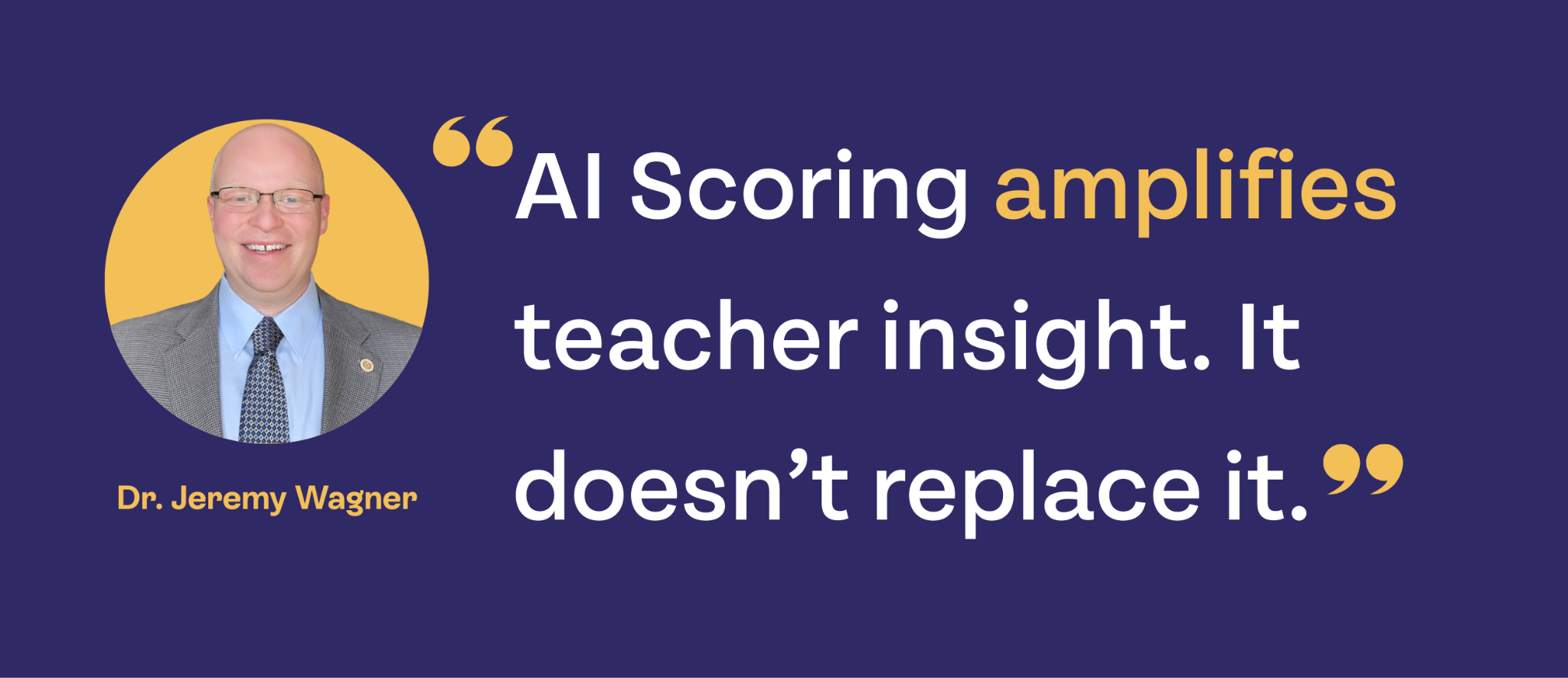
With AI scoring (specifically the AI scoring we developed at Eduphoria), AI can be used to understand a student’s mastery, particularly in constructed-response questions that follow the state assessment rubric.
Just as with TEA hybrid machine scoring, the AI will flag student responses that are ungradable or contain concerning content (such as indications of self-harm or signs of cheating).
Plus, the teacher will have the opportunity to review and override AI scores.
Constructed response questions are some of the most data-rich assessment questions you can get from a student. So, our recommendation would be to always use AI scoring to speed up the assessment of student competency, but to double-check for accuracy, add insight and nuance specific to the student, and incorporate that information into your interventions.
Ethical considerations of using AI to grade

There are many ethical considerations when using AI, especially when assessing student proficiency. Just a few of those considerations include:
- Whether the AI has used copyrighted or stolen content to generate a response
- Whether a student is even old enough to have their responses analyzed by an AI
- Where the student’s responses “go” when entered into an AI, and how their responses are used
- Whether an AI is gathering a student’s personally identifiable information (PII)
- How much energy and natural resources an AI tool uses to generate a response
- Bias in the tool and how that bias will impact student scores and feedback
- Whether it’s “fair” to grade with an AI when a student has put time and effort into their response
If you’d like more in-depth information about some of these ethical considerations, you can refer back to our AI blog. However, we are going to talk about the last bullet in more depth, as there’s a lot of discussion about whether it’s “right” to grade a student’s response with AI.
Is it “fair” to use AI to grade student work?
If you ask yourself this question, it may be hard to pin down exactly what it is about using AI to grade that seems…unfair.
Is it that the student put time and effort into their work, and you’re responding to that very human individual effort with a non-human tool?
If that’s the case, we should definitely talk about how much effort a teacher typically puts in as a single person among a hundred students. There is a huge disparity in effort between the teacher and individual student, not to the fault of the student, but because of the design of a system that designates a single teacher to so many children.
Using a tool to cut down on the amount of manpower it takes to grade wouldn’t mean that a student’s efforts were met with less effort than they deserve. It would mean that the teacher wouldn’t experience such a vast disparity between their own effort and the individual student’s.
Perhaps the feeling of unfairness stems from the idea that their effort won’t actually be seen by a person.
In response to that, let’s think about whether using an AI tool to grade actually means that you won’t see and analyze each student’s responses. Because we are definitely not proposing that an AI tool should be the only eyes on a student’s work.
It would probably be unfair to churn student responses through an AI tool and then hand them back to students with no oversight whatsoever. Not only could this result in a student receiving bad feedback or inaccurate scores, but it would mean that the assignment was simply to receive a score and not to provide information to either the student or the teacher on the next educational steps for progress.
Some may feel that it would be unfair to use a tool that isn’t “good” at what it’s supposed to do. Now, that’s an absolutely understandable way to feel. It certainly would be unfair to use a tool to grade student work that can’t even do that job effectively. If the tool is inaccurate, then the student’s grade, their feedback, and perhaps even their trajectory of progress could be in jeopardy.
If this is the sentiment, then the ethical solution to this problem would be to use a high-quality tool that is accurate, helpful, and adaptable.
Finally, you may feel that using AI to grade is unfair because it doesn’t have the context that you do about each student. You make many subjective judgments about student work every day. Perhaps you know that the student has a learning disorder that makes spelling and grammar more difficult for them. You can then look at that student’s response to assess for different markers of success, such as comprehension of the prompt and the depth of the response.
To that, we nod in agreement. If you’re using an AI tool to grade individuals, then at some point, your knowledge of these individuals needs to feed back into the score, the feedback, and the interventions that follow.
However, there are some times where, at the end of the day, you have to grade according to a rubric and then adjust. AI tools that are prompted and modeled correctly should have no issues grading according to a rubric.
Now that we’ve talked about some of the reasons that you might find using an AI tool unfair, let’s talk about how you could implement AI grading in a way that remains fair to the student.
4 Suggestions for fair and ethical AI grading

You can use an AI tool to grade in a way that is fair to the student. Using the context of the previous section as a guide, let’s get into a few things you can do to make sure you’re being fair to the student.
- Always check the assigned score for accuracy.
The student deserves a grade that reflects their knowledge and skill. You can ensure the tool’s score accurately reflects their mastery.
- Always individualize any feedback the tool gives.
You know what the student needs better than any tool. If the student needs a gentler tone, examples, or encouragement, add it in! Maybe even write the feedback in your own words and voice so the student doesn’t feel that you were removed from the process.
- Do your research on the AI tools that you use.
Make sure that the tool you’re using is approved by your IT specialist, who will know whether a student’s responses and PII are safe from predatory companies and advertisers. You can also determine a tool’s trustworthiness by understanding how it was developed. Was it trained by educators? Was it tested against real data sets with known or expected outcomes? Are there any statistics that can be used to back up claims of quality? Does it use stolen content to train?
- Use the information the AI gives you to do what you do best.
These scores (and the time they may save you) will give you more time and more information with which to help your students. Use the information to get to the “strategy” part of your interventions and enrichment–faster.
Everything you need to know about Eduphoria’s AI tool
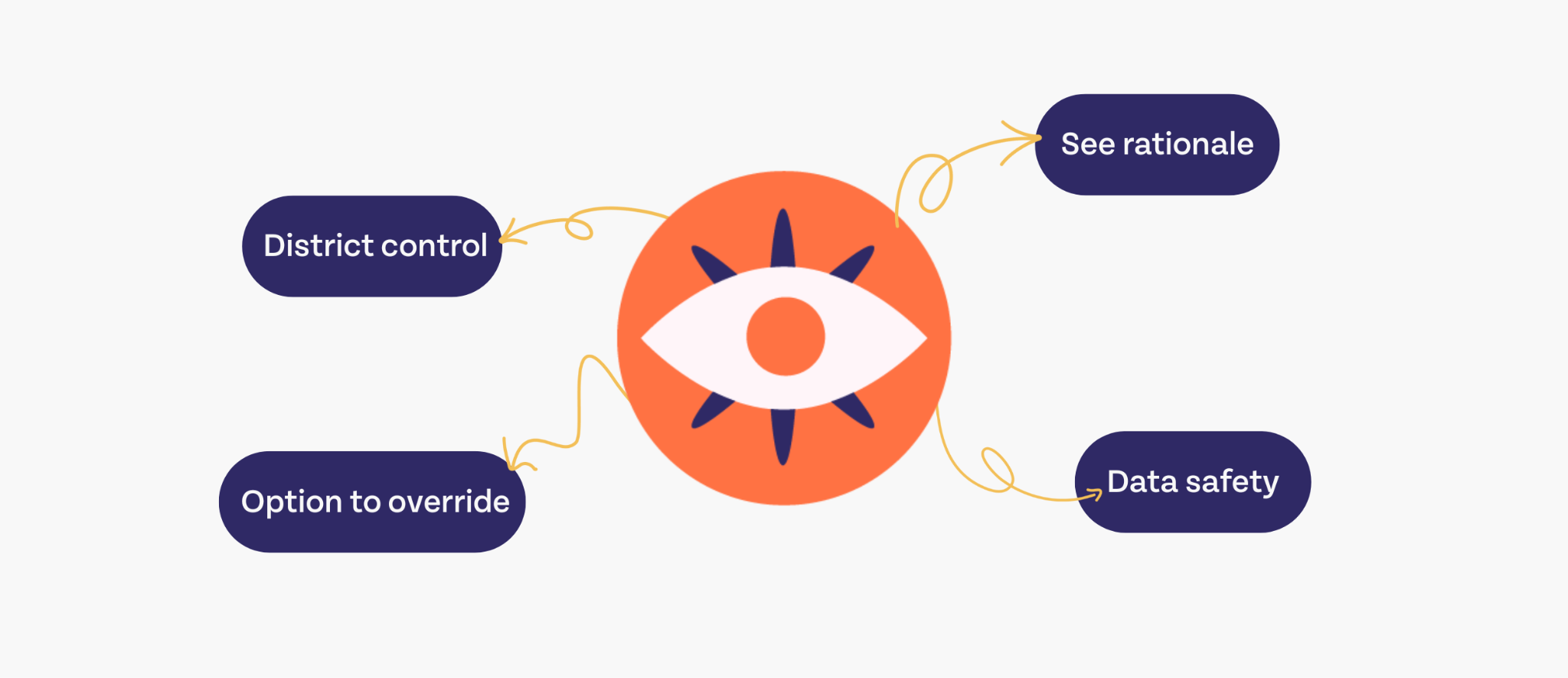
At Eduphoria, we have always valued the teacher as the most qualified individual to make conclusions about student performance, so even through our design of AI scoring, you will see that message ring true.
Our goal is to equip educators with time-saving tools that enable them to focus on students and help them grow.
As we developed this AI tool and discussed the implications of adding it into Aware, we created a document that helped us state and stick to our beliefs about AI scoring throughout the process.
Here is a direct quote from that document:
“Eduphoria stands firm that AI cannot and will not ever replace teachers in the classroom. Our goal is to provide tools that help educators save time, so they can spend more time doing things that really matter for their students. AI Scoring provides an opportunity for increased efficiency, allowing educators to connect with students, provide enrichment, or conduct remediation based on the information gleaned from the scores.”
While you’re considering what AI scoring could offer you, we hope you’ll keep our commitment to you in the back of your mind. Our intention is never to replace you but to empower you with data.
It scores and provides feedback on constructed responses
We built AI scoring into Aware, our assessment creation and data analysis software. It is programmed to grade student constructed responses according to state assessment guidelines. It will provide a number score for the response as well as feedback on what the student could improve.
The teacher can see the rationale for why a score was generated and use it as evidence to affirm or alter that score according to their best judgment.
Your students’ data isn’t used for external model training or storage
Rest assured that your students’ personally identifiable information is safe. The only data sent is the student’s response, and those are not being used to train an external model. The information they provide in their constructed responses isn’t stored in the tool.
Customization is coming
While the tool is restricted to state assessment rubrics for now, we have plans to allow custom rubric creation in the future. This will amplify the opportunities teachers have to assess students on a granular, specific level, or even for district leaders and principals to assess progress on their local learning initiatives.
District leaders have control over the tool’s permissions
We understand that unleashing an AI tool into the educational landscape can be dangerous without proper training, implementation, and guidelines. That’s why permissions are controlled at the district level. Wait until your people are ready and equipped to use the tool appropriately to open it up for use.
If you’d like to hear our expert’s recommendations on implementing our AI scoring tool, please watch our webinar. Dr. Jeremy Wagner goes into great detail about what others in the industry suggest, what we suggest, and what you can do to prepare your staff for AI scoring. You can also download this free one pager including the steps that Dr. Wagner outlines in the webinar.
Ready to talk about AI scoring with us?
We know you probably have a lot of questions. What could this look like for your district? What’s our roadmap for developing AI scoring in Aware? Who is it available to? We’d love to answer your questions and talk about how AI scoring in Aware can lead to student improvement in your area. Hit the demo button below to connect to our team! Whether you’re a current Aware customer or are looking into all of the benefits of Eduphoria tools for the first time, we’d love to hear from you.



%20(1).png)
%20(1).png)
%202.png)
.png)
.png)