



Every year, thousands of bright, deeply committed individuals enter the teaching profession driven by a singular force: passion. They enter the classroom wanting to make a difference, ignite a love for learning, and anchor themselves in the pure joy of the "aha!" moment—that magical instant when a difficult concept suddenly clicks for a student.
For decades, society has treated this passion as an inexhaustible natural resource. We treat teaching as a "calling" or a sacred duty. The cultural narrative tells educators that if they simply love their students enough, sleep deprivation, hours of unpaid overtime, and navigating broken, scattered systems will "never feel like work." Whether you're a teacher or an administrator reading this blog, I'm sure you've felt the strain between love for your career and a deep exhaustion that makes your day-to-day difficult.
But here is the quiet, heavy truth that district leaders, administrators, and educators themselves are discovering: passion is not a shield against burnout. In fact, relying solely on an educator's passion without providing structural, functional support is a fast track to attrition.
To truly serve and retain our educators, we have to look past the romanticized myth of the tireless teacher and start building ecosystems that respect their time, protect their well-being, and simplify their daily work. Later in this blog, we'll talk about tools that can facilitate structural changes for a healthy ecosystem. For now, let's talk about what romanticizing a teacher's job looks like and how that puts teacher retention at risk.
We romanticize teaching to the detriment of teachers

In research, the phenomenon of romanticizing a profession to its own detriment is known as “vocational awe.” Originally coined by researcher Fobazi Ettarh, vocational awe is the set of ideas, values, and assumptions that lead us to believe certain service professions are inherently sacred and good, and therefore beyond critique.
When we place a profession on a pedestal of sacred sacrifice, we inadvertently normalize systemic failures. We begin to equate "being a good teacher" with a willingness to endure martyrdom—accepting job creep, administrative overload, and emotional exhaustion as standard prices of admission.
A comprehensive study published in Frontiers in Public Health titled “From passion to pressure: exploring the realities of the teaching profession” explicitly highlights how unmanaged occupational stress—born from intense workloads, a lack of administrative support, and structural complexity—corrodes an educator's subjective and physical well-being, forcing even the most passionate teachers to contemplate leaving the field entirely.
Similarly, in the book “Drawn to the Flame: Teachers’ Stories of Burnout”, researchers Deja Bailey and Matthew J. Etchells look deeply at how novice educators face an insurmountable wall of pressure post-pandemic. They describe the tragic irony of the educator's journey: the very passion that draws someone to the classroom is often what makes them stay after hours until they break, fighting internal battles of self-doubt while working within dysfunctional or isolated team structures.
That irony? Were they less passionate about their career, they'd be less concerned with the small failures that impact students and could more easily disconnect after their shift ended at 4pm.
Passion drives educators to lean *into* the flame; it is the infrastructure around them that determines whether they are fueled by it or consumed by it.
The Invisible Workload

When educators leave the classroom, they never say, "I stopped caring about the kids." Instead, they say, "I couldn't survive the workload."
As a company that serves and supports school districts, it's easy for us to see the "messiness" in an educator's day-to-day routine. It's our job to identify those friction points and try to solve them. From our perspective, the systemic friction they endure doesn't usually stem from major instructional hurdles, but from a million tiny, structural paper cuts:
- Scattered Systems: Curriculum and resources live in too many disconnected places—half-finished Google Drive folders, old paper templates, legacy software, and personal desktop files. Teachers waste hours hunting for the latest version of a lesson or rebuilding materials that already exist elsewhere in the district.
- The "Compliance Over Collaboration" Trap: Many school districts try to fix planning gaps with well-meaning but ultimately stifling mandates. Whether it's the use of complex templates, adding shared folders, or enforcing professional learning community (PLC) meeting protocols, these added responsibilities weigh down the process instead of freeing it up for the more human, joy-inducing aspects of teaching.
- Reactive vs. Proactive Support: Because administrative and instructional tools are often fragmented, district and campus leaders lack real-time visibility into what is actually happening in the classroom. Coaching becomes reactive (occurring after student assessment data flags a problem) rather than proactive (during the planning phase when a teacher can be actively guided and supported).
Teachers shouldn't have to become software engineers or logistical managers to execute their day-to-day tasks. When we ask our passionate educators to spend their limited time fighting unintuitive tools and chasing compliance over progress, we systematically drain the emotional energy they need for their students.
That's not to say that compliance and administrative tasks aren't also an inherent part of the teacher's day-to-day. These tasks simply cannot become the lion's share of their concerns.
Moving Beyond Standardization: What True Support Looks Like
If passion isn't enough, what is? The answer lies in creating an intentional instructional management layer that bridges the gap between high-level district expectations and the classroom reality, minimizing friction for the teacher.
A healthy educational ecosystem balances two critical elements:
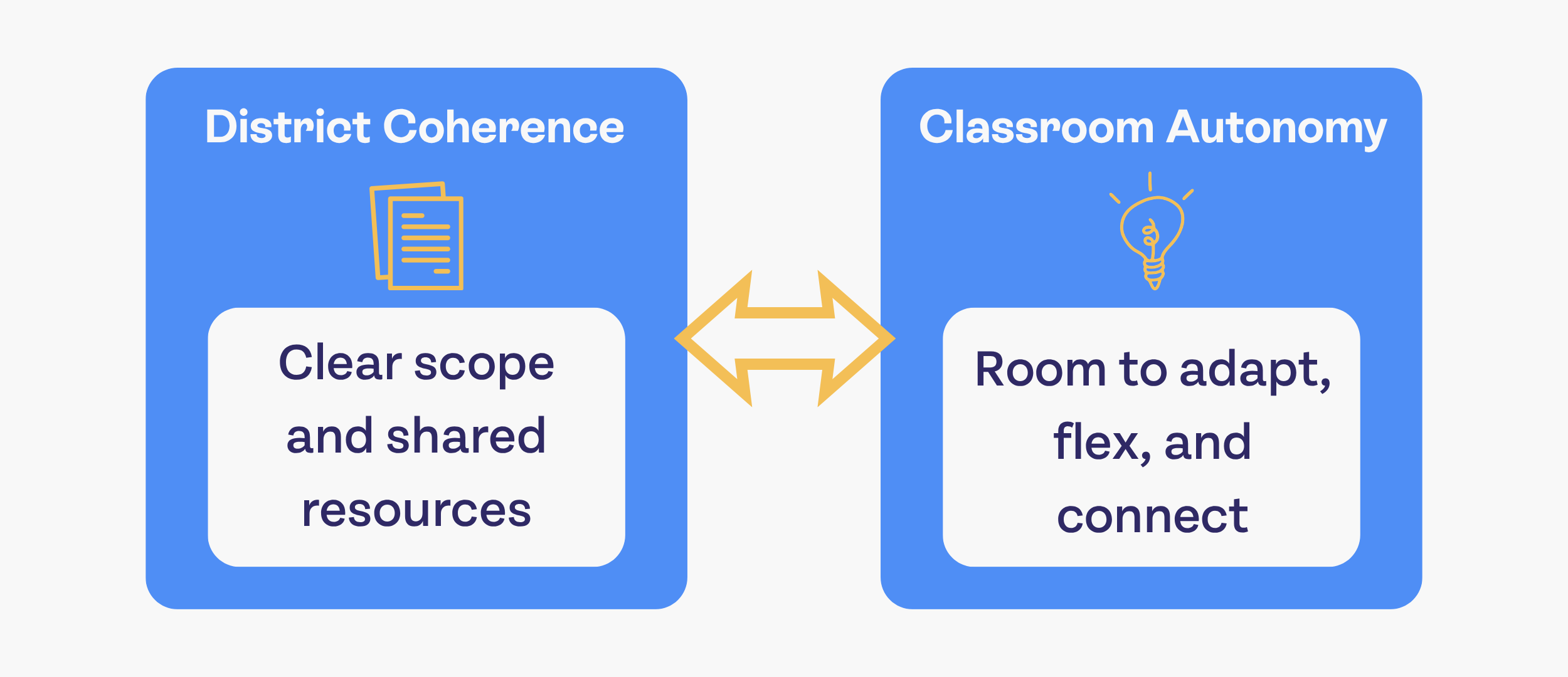
True support does not look like handing a teacher a 500-page pacing guide and telling them to follow it strictly. Especially if that mandate comes with no additional training, guidance, or resources. True support also does not look like leaving them alone in an empty digital room to build everything they need from scratch.
Rather, it looks like providing an intuitive environment where those helpful district resources are centralized, but completely flexible.
1. Reclaiming Time Through Lesson Internalization
A massive shift is occurring in education that steers away from the exhausting cycle of lesson design toward lesson internalization. When districts provide high-quality instructional materials (HQIM) within a centralized platform, teachers don't have to spend their evenings creating materials from scratch. Instead, they can spend their energy internalizing the lesson—intellectually preparing for how to adapt it, differentiate it, and deliver it effectively to meet the unique cultural and academic needs of the specific human beings sitting in front of them.
HQIMs are taking some of the time-intensive burden of resource creation off of the teacher's plate. These resources provide that necessary district coherence through helpful and trustworthy materials while also allowing teachers to do what they do best: use their expertise to support students. Thus, the healthy educational ecosystem helps teachers thrive.
2. Live, Active Collaboration
True PLCs shouldn't be defined by an extra meeting added to an already packed calendar. Support means giving teacher teams a shared planning environment where collaboration happens seamlessly within the daily workflow. When a team can co-create, share formatting, and tag standards in real time without version-control headaches, the collective workload drops significantly.
Not only are teachers allowed to share their expertise and improve the quality of instruction, but they can use the time they save to invest their passion in teaching tasks that fuel them rather than consume them.
3. Giving Leaders Eyes to Help Early
Administrators want to support their teachers, but they cannot fix a problem they cannot see. True systemic support means giving campus coaches and district leaders clear visibility into planning trends and scope-and-sequence coverage *before* high-stakes testing occurs. This transforms evaluation and coaching from an intimidating, retrospective judgment into an active, side-by-side partnership focused on professional growth.
Raising the Standards Beyond Standardization: How Eduphoria supports teachers
At Eduphoria, we have spent twenty years rooted in a singular, foundational belief: educational software should adapt to the needs of educators, not the other way around.
Our team is composed of current and former educators—teachers, administrators, and district leaders who transitioned out of the classroom with a desire to fix the broken systems that cause passionate people to burn out. We know firsthand that for educators, this work is a calling. But we also know that a calling deserves an infrastructure that honors it.
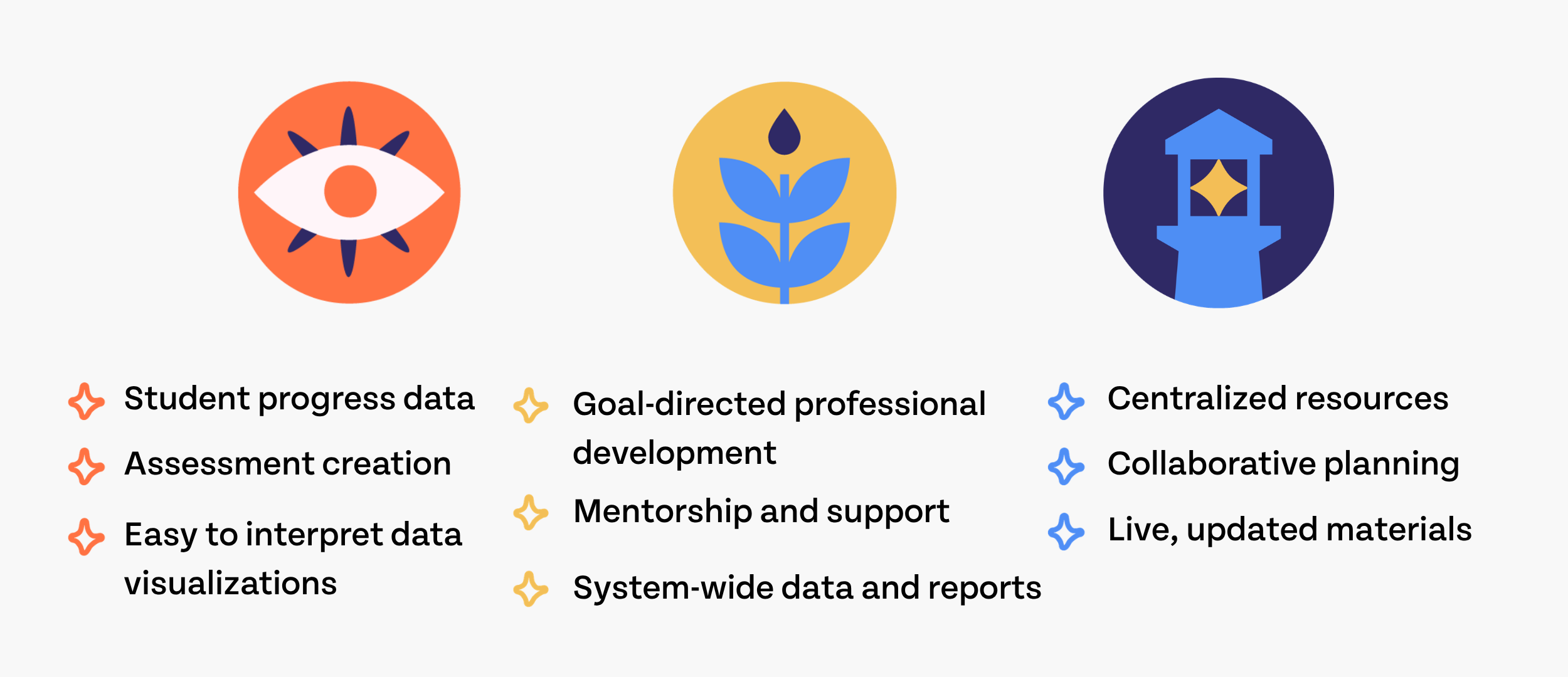
Through platforms like Beacon (our curriculum and lesson planning solution), Aware (our assessment and data visualization engine), and Strive (our professional development and growth management system), we aim to put hours back into an educator's schedule. We work to eliminate the "lost curriculum," lower the administrative burden, and replace isolated work environments with real-time, functional community spaces.
We want to simplify the "aha!" moment—not just for students, but for the educators who guide them there. We want to raise the standards of our educational systems beyond basic standardization, ensuring that impactful learning is fueled by an educator's individual passions, rather than limited by scattered tools and logistical weight.
A Call to District Action
To the superintendents, chief academic officers, and school board members leading our districts: your teachers have the passion. They brought it with them on day one. But that passion requires a foundation of operational excellence to survive.
When evaluating your district's tools, strategies, and initiatives for the upcoming school year, bypass the focus on compliance that weighs down your teachers. Instead, ask the hard, human questions:
- Does this tool add hours of technical frustration to a teacher's week, or does it return time to their day?
- Are our teams planning in isolated silos, or are we giving them a unified environment to share the heavy lifting?
- Is our instructional coaching a reactive post-mortem, or a proactive support structure?
We are confident that asking and answering these questions will solve your compliance frustrations, too. Supported teachers support students. Supported teachers solve problems. That's the healthy educational ecosystem at work.
.png)



%20(1).png)
%20(1).png)
%202.png)
.png)