


.png)
And should you be implementing through-year assessments?
As of 2026, several states have already implemented a through-year testing model. Some, including Texas, are testing through-year pilot programs to help them decide whether this assessment model should replace their summative assessments. Both models have benefits and drawbacks.
Summative assessments can direct a student’s learning by “communicating what they need to learn.” However, the more valuable indicator of lifelong learning is the student’s ability to make “evaluative judgments.” In other words, they assess the quality of their work or their peers’ work against a standard (Fischer, J., Bearman, M., Boud, D., Tai, J.).
According to research by Fischer et al., summative assessments do teach students to make evaluative judgments, including the best ways to solve problems and further their studies beyond a simple checklist of “what they need to learn.”
Conversely, through-year assessments correlate well with summative assessments in terms of rigor and performance while causing less stress, offering more flexibility, and increasing opportunities for growth (Marzano Research). The best approach according to this study? A combined assessment model that includes interim assessments, classroom work, and focused performance tasks.
Before we can really decide which tests (and at what frequency) are best for student learning, we’ll need to dig into these different assessments. What is the purpose behind each model of assessment, and what are the effects of each on students and schools?
Standardized tests are meant to mark a student’s performance compared to pre-determined criteria

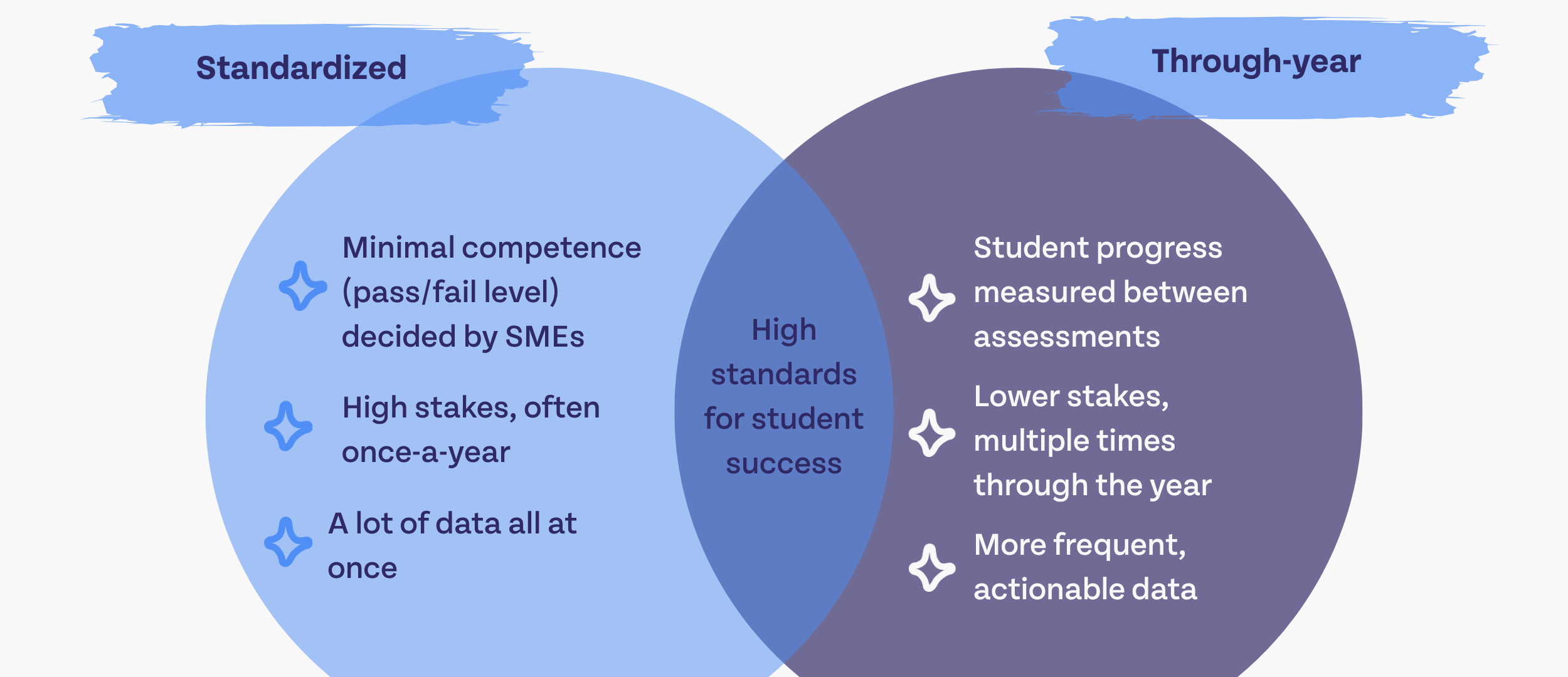
Most state assessments are criterion-referenced, meaning a student’s success on that assessment is evaluated by specific criteria. These criteria for student success were predetermined by a group of Subject Matter Experts (SMEs), who defined the minimum level of competence in that subject. This is where we get designations of student performance you may be familiar with, such as “Does Not Meet Grade-Level,” “Approaches Grade-Level,” “Meets Grade-Level,” and “Masters Grade Level.”
This minimum competence designation is the “cut-off” point. Below this level, the tester fails. Above, they pass.
This may raise the question–who decides the cut-off point? Is the cut-off point arbitrary? Can it be changed?
According to one resource from Brigham Young University, the cut-off point is determined by a panel of experts, empirical data, and politics. The test's difficulty is also a consideration. A student who is considered “minimally competent” (the official terminology for a student who meets the criteria for a passing grade) might perform better on an easier test than a more difficult one. The goal is for the standard to be consistent across assessments, regardless of difficulty.
This is one reason that difficult summative assessments, such as state standardized tests, often use scaled scores or percentiles rather than raw scores.
Political consideration of test performance may come from a governing body, such as state government officials, determining the “maximum acceptable failure rate.”
There are many ways to determine the cut-off point separating passing students from failing students. Overall, the purpose of a summative, standardized assessment is to determine whether a group of students meets predetermined standards for what constitutes a successful student.
Through-year assessments are meant to track progress

Through-year assessments can still be created and administered by state entities, districts, or schools. They can even be “standardized” in the sense that the assessment is consistent across settings, formats, and content, ensuring that other random variables don’t interfere with performance data. Standardized simply means “following a consistent standard.”
The major difference between standardized summative assessments and standardized through-year assessments is the purpose behind the test.
Through-year assessments are meant to track progress. These tests probably won’t go into the gradebook because that is not the point behind the score. If a student performs poorly on the first assessment, that doesn’t reflect on the student’s lack of effort or the teacher’s skills. The first assessment in a series of through-year assessments gives a starting point for that student’s knowledge, so the teacher can track their growth through subsequent assessments.
That student’s final through-year assessment should be much better than their first assessment.
The students are competing with themselves to perform better
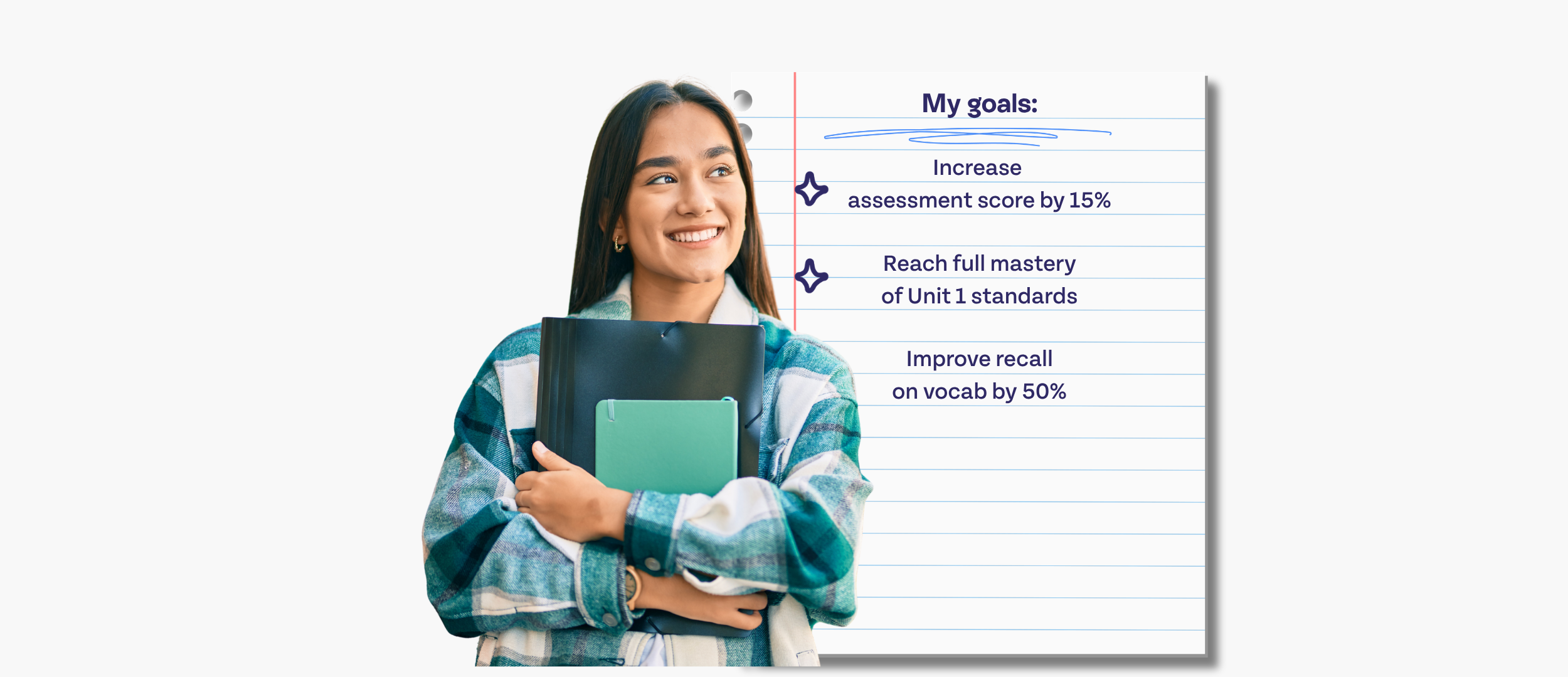
One of the things we often discuss in our publications is that, for students and teachers to enjoy education more, we need to foster student ownership. One way to foster student ownership is to include students in their data journey. You help them create goals and give them ownership over their success.
When they don’t feel like it’s the teacher in charge of whether or not they fail, pass, or get the grade they want, they feel more responsible, more engaged, and more determined to learn what they need to learn.
Through-year assessments can be a great, neutral way to engage a student in their data. Because their performance doesn’t result in a grade, there’s no shame in a bad score. All that score indicates is that there are opportunities for growth. And when they see growth, they feel great! They have something to celebrate! And they can feel the pride they deserve to feel for getting themselves to that point.
There are advantages and disadvantages to each testing system
We do not want to give the impression that one testing system is superior to the other. Assessments always have a purpose. Ideally, they provide data that supports student growth and drives systemic change. Both summative and through-year assessments can accomplish that goal.
However, doing one type of assessment without giving other assessments a chance will limit the kinds of data you collect and the frequency of that collection, making it more difficult for you to proactively address challenges in your community. Summative assessments provide a lot of data, but you typically only get that data once a year. If you’re always reacting to last year’s data, you’ll never feel like you’re caught up and supporting students now.
So, don’t throw out your assessment system wholesale. Let’s talk about what it might look like for teachers, administrators, and district leaders to implement through-year testing in addition to their summative assessments, so they can get more data to support student growth today.
How to implement your own version of through-year testing
You might be thinking, “I don’t have any control over what assessment system we use in my current role. How am I supposed to make systemic change?” That’s a great question. Regardless of your current role, you do have the power to make systemic change within your own system.
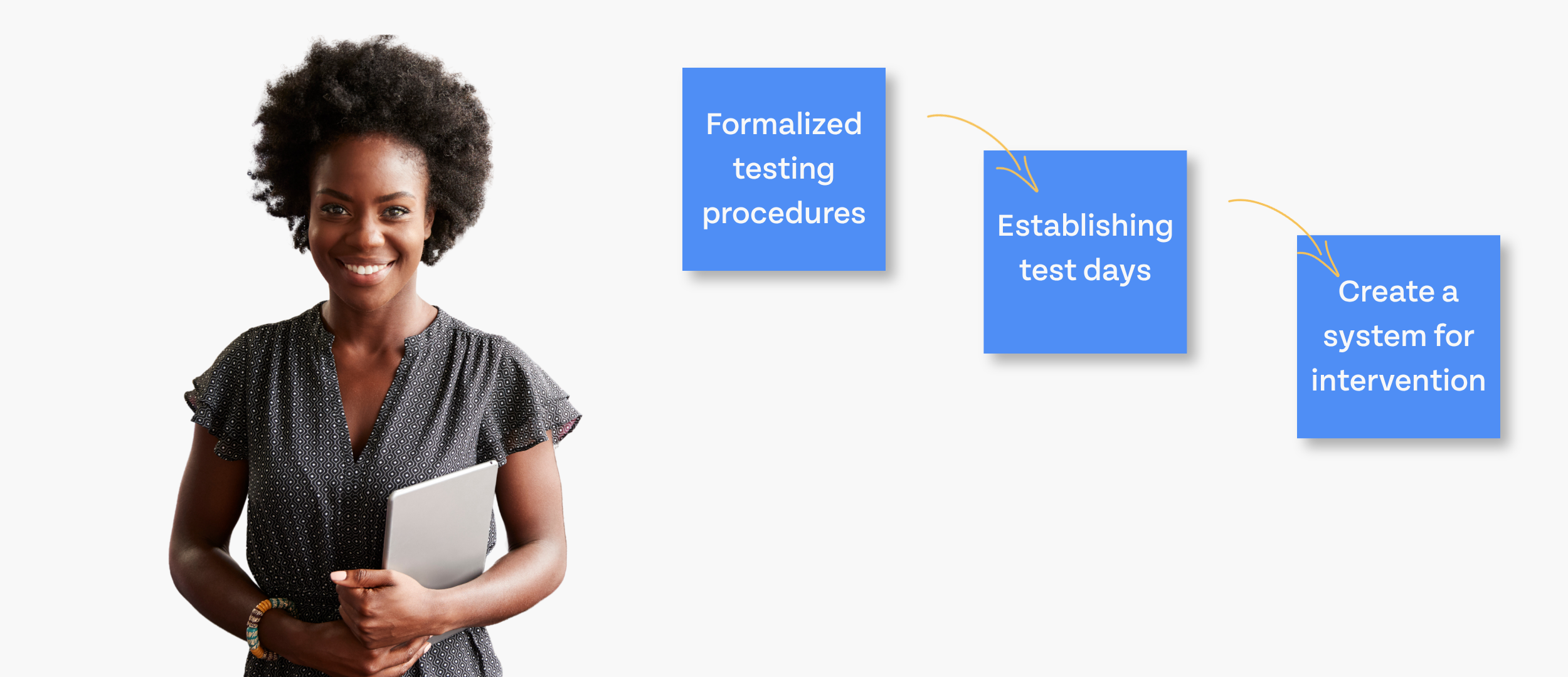
Implementing through-year testing requires “formalization” of existing processes
What does your assessment process look like right now? If we had to guess, you’re likely doing your required summative assessments. Perhaps your district also requires intermittent testing. Do you do surveys, exit tickets, or check-ins with students? If so, you probably have all of the required pieces to create a through-year assessment program in your own classroom.
What you’re likely doing in between your more formal assessments is what we call formative assessments. Formative assessments more casually assess a student’s progress. For example, if you give your students an exit ticket asking them what they’re confused about in the current unit or after a lesson, you’ve just assessed them.
The way you change this into a “program” is by formalizing it.
Formalizing your assessment process makes the data more reliable.
For a second, let’s talk about why it’s important that your data is reliable.
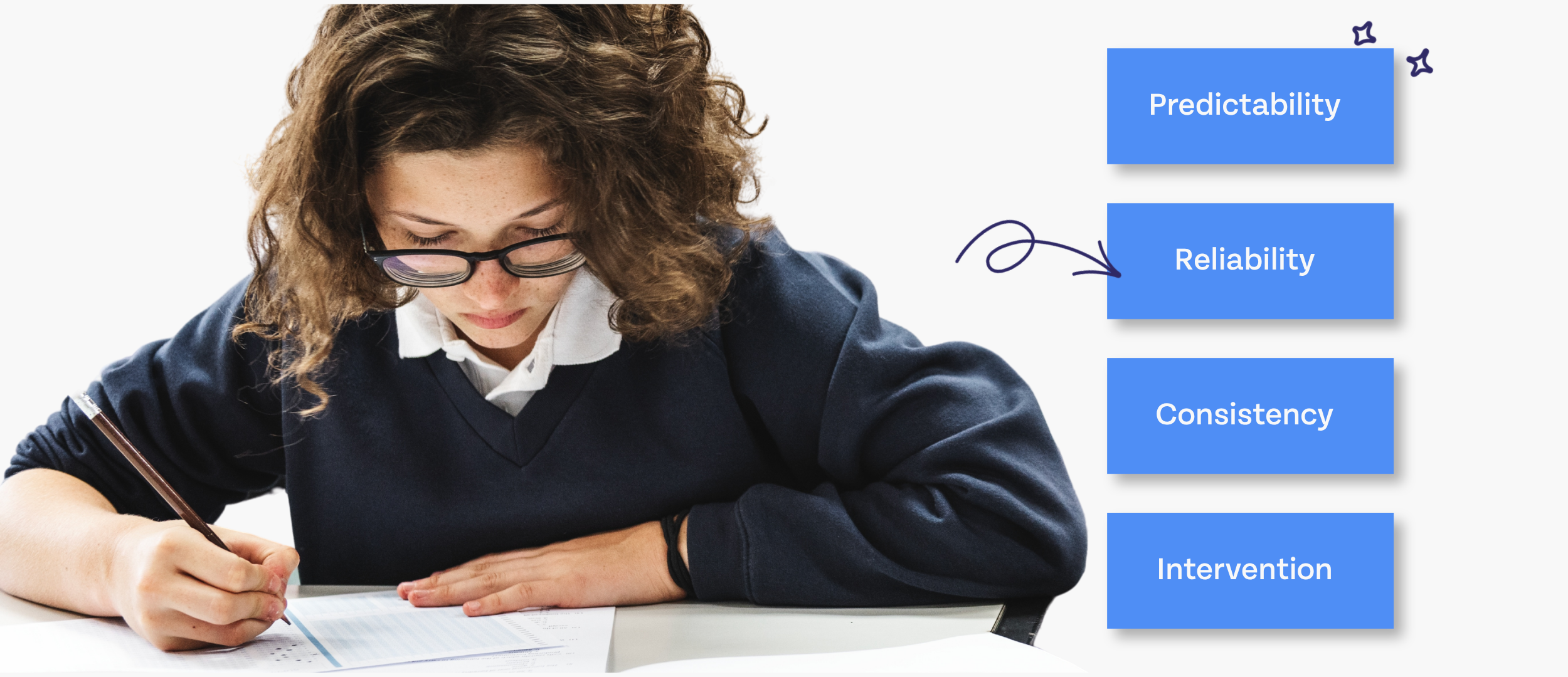
Reliability refers to the consistency of that data or that assessment. If you administer the same test to different students of a similar demographic makeup, then you should get similar results on that assessment. An assessment may be unreliable if it has different questions, different difficulty levels, or even if the testing environment changes between administrations.
Here’s a common example of when an assessment may become “unreliable.” You have a student who missed an assessment, and you need them to make it up quickly. Rather than having them come in before or after school so they can have a solid hour of quiet to take their test, the student is asked to take their test during a busy class period where students are talking, people are getting up and walking around, and perhaps their attention is divided between the assessment and what’s going on around them.
The data from this assessment may not be reliable because their testing environment was very different from that of their peers. That means that the conclusions you draw from that data may not be accurate. Let’s say this student, who was asked to take the test during a regular class period, does not perform well. They rush through the test so they can join their classmates. Consequently, they miss a lot of questions that they wouldn’t have missed had they felt unrushed.
That data can’t be relied upon to create interventions and enrichment.
So, how can you formalize your assessment program?
Formalize your testing process by meeting these requirements
So, how can you formalize your assessment program?
First, decide what you are trying to measure. If your goal is to track student growth throughout the year, each assessment should connect back to the same skills and learning goals that your district is working towards. The assessments do not need to be identical, but they should be consistent in purpose and expectations. Otherwise, you may get data without actually knowing whether students are growing.
You also need to think about when, and how, students will be assessed. Through-year testing works best when assessments are spaced throughout the year, giving teachers time to collect and respond to data, and measure whether students improved. Students should also have the same amount of time, instructions, and testing environment each time so the data reflects what they know, instead of outside variables.
Once that structure is in place, the final step is deciding how to take data-driven action. Through-year assessments are mainly helpful if the results lead to action. Teachers should be able to see which students need support, which are ready for enrichment, and which skills may need to be retaught. This is what turns a few check-ins throughout the year into a reliable system for understanding student growth and thinking ahead.
Aware is your solution to implement through-year testing with fidelity
So, what does it look like to support this kind of assessment process with the right tools?
If through-year testing depends on consistency, then districts need a system that helps educators create, administer, and analyze assessments in a consistent way. Aware gives teachers and leaders one place to build and administer assessments, collect results, and track student progress throughout the year. That makes it easier to compare data across assessments and student groups without juggling spreadsheets or complex data tables.
This is especially important because through-year testing only works when the data is easy to understand. If assessment results live in paper files, spreadsheets, or disconnected systems, teachers may not get the information they need quickly enough to respond. Aware helps bring that data together so educators can see where students stand.
Through-year assessments are not just about testing more often, they are about giving educators better information to take action. If your district is ready to make assessment data more reliable and actionable, Aware can help you implement through-year testing with fidelity.
Schedule a demo to learn more about Aware




%20(1).png)
%20(1).png)
%202.png)
.png)